

Guide · Lease law basics
Assignment and sublease: why your name can stay on the lease
Handing your lease to someone else doesn’t always hand over the responsibility. Here’s the difference between assigning and subletting, and how to protect yourself. In most cases you stay liable after an assignment unless the landlord releases you in writing.


Two different things
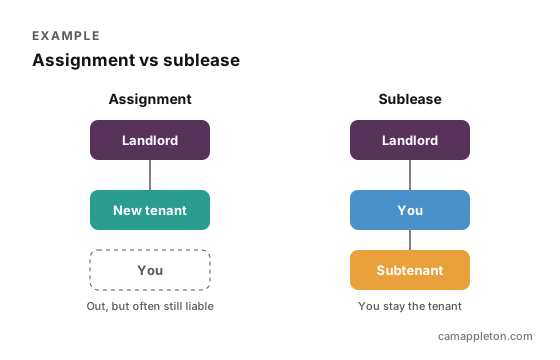
- Assignment: you transfer your whole interest in the lease, for the rest of the term, to a new tenant. The new tenant deals with the landlord directly.
- Sublease: you stay the tenant and rent all or part of the space to a subtenant, for less than your remaining term (even one day less). You stay responsible to the landlord, and the subtenant pays you.
Liability usually survives an assignment
This is the one that surprises people. In most cases, the original tenant stays liable under the lease after an assignment. If the new tenant stops paying, the landlord can come back to you and your guarantors. Many leases say this outright.
The fix is a release: a written agreement from the landlord that frees you, and ideally your guarantors, once the assignment is done. Landlords don’t always agree, but it’s one of the most valuable things to ask for. On a long lease it can be worth more than a few months of free rent.
Landlord consent
Most leases need the landlord’s consent to assign or sublet. Many say consent can’t be unreasonably withheld. Watch for:
- Recapture clauses: the landlord can take the space back instead of consenting.
- Profit sharing: the landlord takes a share if you sublet for more than you pay.
- Conditions: financial statements, a new guarantee, an admin fee, legal costs.
- Change of control: selling the shares of your company may count as an assignment under the lease.
Where this comes up
Selling your business, downsizing, moving early, and restructuring a company. In each case, start with the clause and plan the landlord ask early. See selling your business and downsizing.
If neither works, the other way out is a lease surrender, where you and the landlord agree to end the lease early.
The exact words matter
If a lease says nothing about it, a BC commercial tenant can assign or sublet without asking. Most leases restrict it, and courts read those restrictions strictly. A clause that only bans assigning may not stop a sublease, and one that only bans subletting the premises may not stop you subletting part of them. A sublease also has to leave you at least the last day of your own term, or it’s treated as an assignment. Read your clause with your lawyer before you plan around it. See commercial lease rules in BC.
Questions people ask
What is the difference between assignment and sublease?
An assignment transfers the whole lease for the rest of the term to a new tenant. A sublease keeps you as the tenant and rents the space to a subtenant for less than your remaining term.
How do I get released from a commercial lease when I sell my business?
Ask the landlord for a written release as part of their consent to the assignment. Without one, you and any guarantors may remain liable if the buyer defaults.
Go deeper
If you’re looking for more details
Assignment or sublease?
| Assignment | Sublease | |
|---|---|---|
| What moves | The whole lease | Some or all of the space, for part or all of the term |
| You stay liable? | Usually, unless released | Yes |
| Typical use | Selling the business | Extra space, downsizing |
| Landlord consent | Usually needed | Usually needed |
Search
Not quite your situation? Search
Next step
Hand off your lease cleanly.
Tell me what’s happening. I can map out the cleanest route.