

Guide · Buying
Cap rates, explained like a savings account
If you bought a building with cash, the cap rate is the interest rate it would pay you. It’s the simplest number in commercial real estate, and one of the most useful. Cap rate equals net operating income divided by price. A building earning $150,000 a year in NOI and priced at $3 million has a 5% cap rate.


General information, not tax or legal advice. The numbers here are illustrative. Talk to your lawyer and accountant before you act on them.
The basics
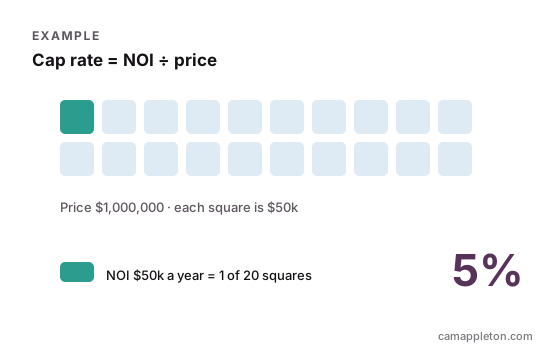
Cap rate = net operating income ÷ price
Net operating income (NOI) is the rent you collect minus the costs of running the building, before mortgage payments. If you pay $1 million and the building puts $50,000 a year in your pocket after expenses, that’s a 5% cap rate.
A higher cap rate means more income for your money, usually with more risk: an older building, a weaker area, a shaky tenant. A lower cap rate means you’re paying more for safety: a newer building, a strong tenant, a great location.
Half a point of cap rate is a lot of money
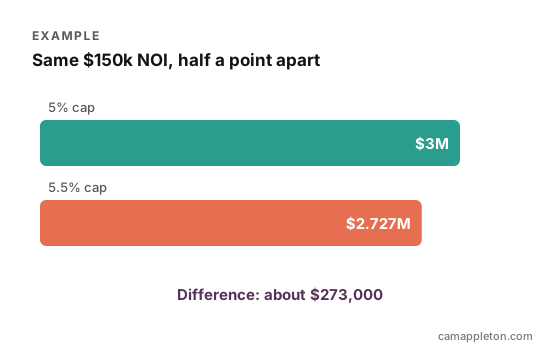
A building with $150,000 of NOI is worth $3,000,000 at a 5% cap rate and about $2,727,000 at 5.5%. Half a point is roughly $273,000. So when someone tells you what a building is worth, ask what cap rate they used and how it compares with recent sales nearby.
Check the NOI before the cap rate
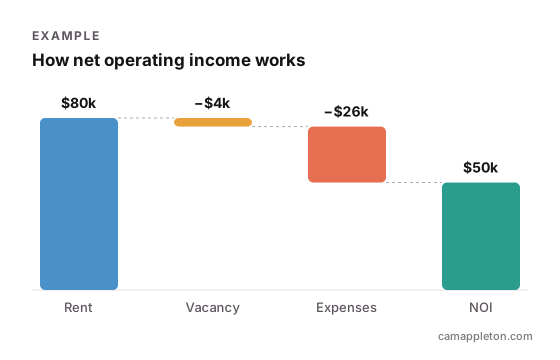
A cap rate is only as good as the income behind it. Rebuild the NOI yourself: actual rents, not asking rents; real vacancy; every expense; when each lease ends. Buying on pro forma rents is how people overpay.
Why tenants should care
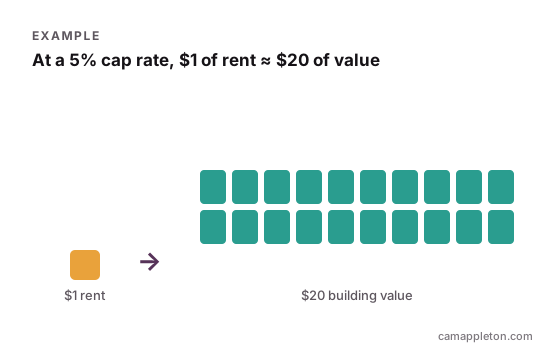
Landlords think in cap rates. At 5%, each $1 of yearly rent adds about $20 to the building’s value. That’s why they protect face rent and offer free rent and allowances instead.
How landlords think uses this to your advantage.
Work the cap rate from actual income
A cap rate is only as good as the income behind it. If an asking cap rate uses projected rents, or leaves out vacancy, management or reserves, it makes the property look cheaper than it is. Rebuild the net operating income from the actual rent roll and statements, then apply the cap rate.
Questions people ask
How do you calculate a cap rate?
Divide the building’s yearly net operating income by its price. $50,000 of NOI on a $1,000,000 price is a 5% cap rate.
Go deeper
If you’re looking for more details
Worked example
A building earns $120,000 a year in rent and other income, and costs $30,000 a year to operate. Net operating income is $90,000. At a price of $2,000,000, the cap rate is $90,000 ÷ $2,000,000 = 4.5%.
What a cap rate doesn’t tell you
- Whether the rents are above or below market
- How long the leases have left
- Upcoming repairs
- The effect of your mortgage
Search
Not quite your situation? Search
Next step
Check the numbers on an investment property first.
Send me the listing. I can rebuild the numbers with you.