

Guide · Lease types
What triple net really costs
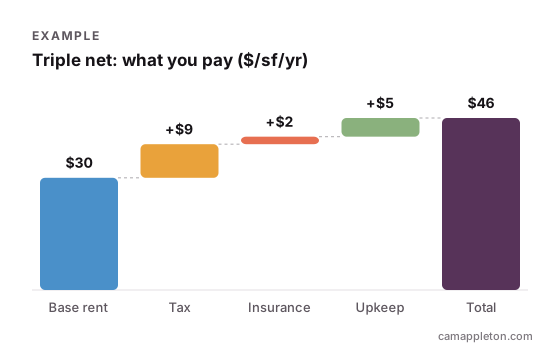
“Net” sounds like less. In a lease it usually means more on top. Here’s what each lease type passes to you, and how to budget for it. In a triple net lease you usually pay your share of property tax, insurance and maintenance on top of base rent, plus GST.

General information, not tax or legal advice. The numbers here are illustrative. Talk to your lawyer and accountant before you act on them.
Gross vs net
In a gross lease, one rent covers the space and the building’s costs. In a net lease, you pay base rent plus your share of the building’s costs as additional rent.
- Single net (N): you pay a share of property taxes.
- Double net (NN): taxes and insurance.
- Triple net (NNN): taxes, insurance and maintenance or operating costs. This is the most common setup in Vancouver commercial leasing.
- Absolute net: you also carry major repairs and structural costs. Less common, and worth reading twice.
The easy way to remember NNN: taxes, insurance and maintenance. Leaving insurance out is the classic budgeting mistake.
What goes into additional rent
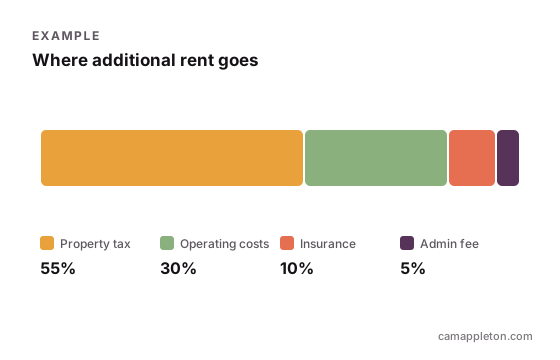
Property taxes, building insurance, and operating costs (often called CAM): cleaning of common areas, repairs and maintenance, landscaping, snow removal, security, utilities for common areas, property management and often an administration fee. The lease defines what’s in and what’s out, and that definition is negotiable.
How it’s billed
You pay a monthly estimate. After the year ends, the landlord reconciles actual costs and either bills you the difference or credits you. Ask for the last two years of statements before you sign, so the estimate isn’t a guess.
“Gross” isn’t always flat
Many gross leases have an escalation clause, often a base-year stop: the landlord covers costs up to the first year’s level, and you pay your share of any increase after that. So a gross lease can still go up. Read the clause.
What to negotiate
- Exclusions for capital costs, major structural repairs and the landlord’s financing costs.
- A cap on yearly increases in controllable operating costs.
- Limits on the admin fee.
- A right to review supporting records.
Questions people ask
What does NNN include in a commercial lease?
Triple net usually means the tenant pays a share of property taxes, building insurance and maintenance or operating costs on top of base rent. The lease defines exactly what is included.
Is a gross lease better than a net lease?
Not automatically. A gross lease is simpler to budget, but the rent is set higher to cover costs, and many gross leases still pass on increases above a base year. Compare total cost over the term.
Go deeper
If you’re looking for more details
What’s usually in additional rent
- Property tax
- Building insurance
- Repairs and maintenance of common areas
- Cleaning, security and landscaping
- Common-area utilities
- A management or administration fee
What to ask for
- The last two or three years of actual costs
- What is excluded, such as structural repairs or capital replacements
- A cap on increases to controllable costs, where the landlord will agree
- The right to review or audit the year-end statement
Search
Not quite your situation? Search
Next step
Find out what your additional rent covers.
Send me last year’s statement. I can go through it with you.