

Guide · Buying · 2027
What cap rates really say in 2027
A cap rate is still the quick way investors talk about price. After 2022, the interesting question is whether the debt still works. Here’s how to read the number in 2027.
For: Buyers comparing buildings · Owners thinking about price


General information, not tax or legal advice. Talk to your lawyer and accountant before you act. Numbers here are illustrative, not a quote on any property.
What a cap rate actually says
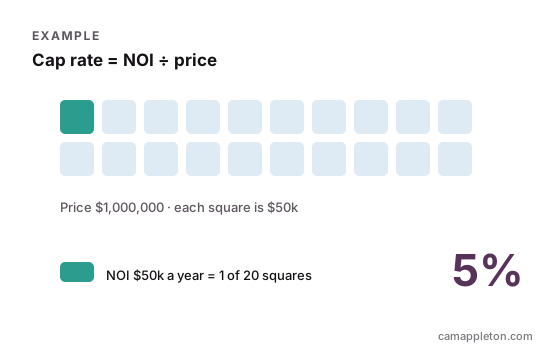
A capitalization rate (cap rate) is a pricing shorthand: net operating income (NOI, the income left after running costs) divided by the purchase price. A 5% cap on $500,000 of NOI implies a $10 million value, if you trust that NOI.
The post-2022 context heading into 2027
After 2022, borrowing costs rose and the old easy gap between cap rates and mortgage rates got thin. On many deals the mortgage rate sat close to, or above, the going-in cap rate. That is called negative leverage: debt that doesn’t improve your cash yield.
When that happens, lenders lean harder on debt service coverage (can the NOI pay the loan?) and buyers bring larger down payments. Prices adjust through higher cap rates, lower NOI assumptions, or both. For 2027, treat any “market cap rate” claim as something to verify against recent local sales and a current lender quote, not a blog from 2021.
Bank of Canada policy and Government of Canada bond yields still set the backdrop for commercial mortgage pricing. Spreads move. Your broker’s quote on this building matters more than a national average.
Questions that keep you honest
- Is the NOI trailing actual, trailing adjusted, or pro forma?
- Which one-time items were added back, and which vacancies were “stabilized”?
- What cap rates did similar buildings nearby actually trade at in the last year?
- What debt service coverage and loan-to-value would a lender offer on this rent roll today?
- If rates stay sticky into 2027, does the deal still clear with a bigger down payment?
Example only, not a real client. Say a listing quotes a 4.5% cap on “stabilized” NOI. The trailing bank deposits support a lower NOI. At the real number the cap is closer to 4.0% at the asking price. A lender’s DSCR test then caps the loan well below what the brochure assumed. You either renegotiate price or bring more cash.
What I’d tell a friend
In 2027, a cap rate is still useful, and still easy to dress up. Ask how NOI was built, then ask what a lender will actually lend. The cap rate calculator helps you see the price math quickly.
Related: cap rates guide, reading a rent roll, cap rate, DSCR.
Questions people ask
What does a cap rate tell you in 2027?
A capitalization rate (cap rate) is net operating income divided by price. It is a quick pricing shorthand, not a full return. In 2027 you still have to ask what NOI was used, what was left out, and how the rate compares with financing costs.
Why did cap rates move after 2022?
When interest rates rose after 2022, the gap between property yields and borrowing costs narrowed. Buyers needed higher cap rates (lower prices) or bigger down payments to make the debt work. Always check current lender quotes rather than old headlines.
Is a higher cap rate always better?
Not by itself. A higher cap rate can mean higher income relative to price, or it can mean more risk, weaker tenants, or deferred maintenance. Compare similar buildings, then dig into the rent roll.
Go deeper
Plain-English definitions with BC sources, from the encyclopedia:
Next step
Want a plain read on a listing’s cap rate?
Send the rent roll and the asking price. I can help you pressure-test the NOI and the debt story.
Search