

Guide · Buying · 2027
How BC lenders size a commercial loan in 2027
LTV sets a ceiling. DSCR often sets a lower one. Here’s the plain way BC commercial loans get sized heading into 2027.
For: Buyers planning a down payment · Owners refinancing

General information, not tax or legal advice. Talk to your lawyer and accountant before you act. Numbers here are illustrative, not a quote on any property.
Two levers: LTV and DSCR
Commercial lenders in BC rarely size a loan on purchase price alone. They look at loan-to-value (LTV) and debt service coverage ratio (DSCR), then take the lower result.
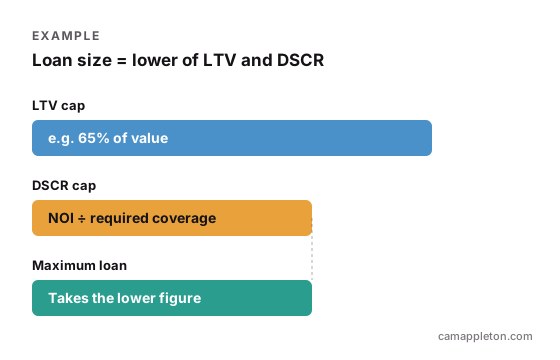
- LTV: loan ÷ value (or purchase price). Public lender pages often show commercial programs somewhere in a mid-range band (examples in the market have landed roughly in the mid-50s to mid-70s percent, depending on asset and borrower). Treat any number as a starting point to confirm with a broker.
- DSCR: NOI ÷ annual debt service. If the building’s income won’t cover the payment with the lender’s required cushion, the loan is cut until it will.
How sizing feels in 2027
When mortgage rates sit close to cap rates, DSCR is usually the binding constraint. That is why two buyers can look at the same building and get different maximum loans: rate hold, amortization, stress test, tenant quality and borrower strength all move the needle.
Typical term sheets you’ll see discussed in the market (always verify): terms of about 3 to 5 years, amortizations around 25 years, and a DSCR floor often near 1.20x to 1.25x. Owner-occupied deals may weigh the business financials more. Investment deals lean on the rent roll and lease quality.
A plain way to work the number
- Get a realistic NOI (trailing actual, not brochure pro forma).
- Ask a commercial mortgage broker for a rate and amortization quote on this asset type.
- Compute the maximum loan that still clears the lender’s DSCR floor.
- Compare that with the LTV cap on the same value.
- The lower figure is your working max loan. The rest is equity.
Example only, not a real client. Say NOI is $420,000. A lender wants 1.25x DSCR. Annual debt service can’t exceed $336,000. At a given rate and 25-year amortization, that supports a loan of about $X. If 65% LTV on the price would have allowed more, DSCR still wins and you bring a larger down payment, or you renegotiate price.
I’m not quoting a live rate here on purpose. Rates move. Get a current quote.
What I’d tell a friend
In 2027, don’t fall in love with an LTV headline. Ask what loan the DSCR supports at today’s quote. Then decide if the down payment still fits.
Related: financing commercial property, DSCR, LTV, cap rates in 2027.
Questions people ask
How do BC commercial lenders size a loan in 2027?
Most lenders look at both loan-to-value (LTV) and debt service coverage ratio (DSCR). Whichever limit is tighter usually sets the maximum loan. Terms are often in the 3 to 5 year range with amortizations around 25 years, but every quote is deal-specific.
What is DSCR?
Debt service coverage ratio is net operating income divided by the annual mortgage payment. A common minimum is around 1.20x to 1.25x, though lenders set their own floors by property type and borrower.
Why can’t I borrow up to the LTV headline?
Because DSCR often bites first. If the income won’t cover the payment at today’s rate with the lender’s cushion, the loan shrinks even if the LTV cap looked higher on paper.
Next step
Buying and want a sense of the loan?
Share the rent roll and target price. I can help you frame the questions for a commercial mortgage broker.
Search